Discounts up to 40% on new books

Discounts up to 40% on new books

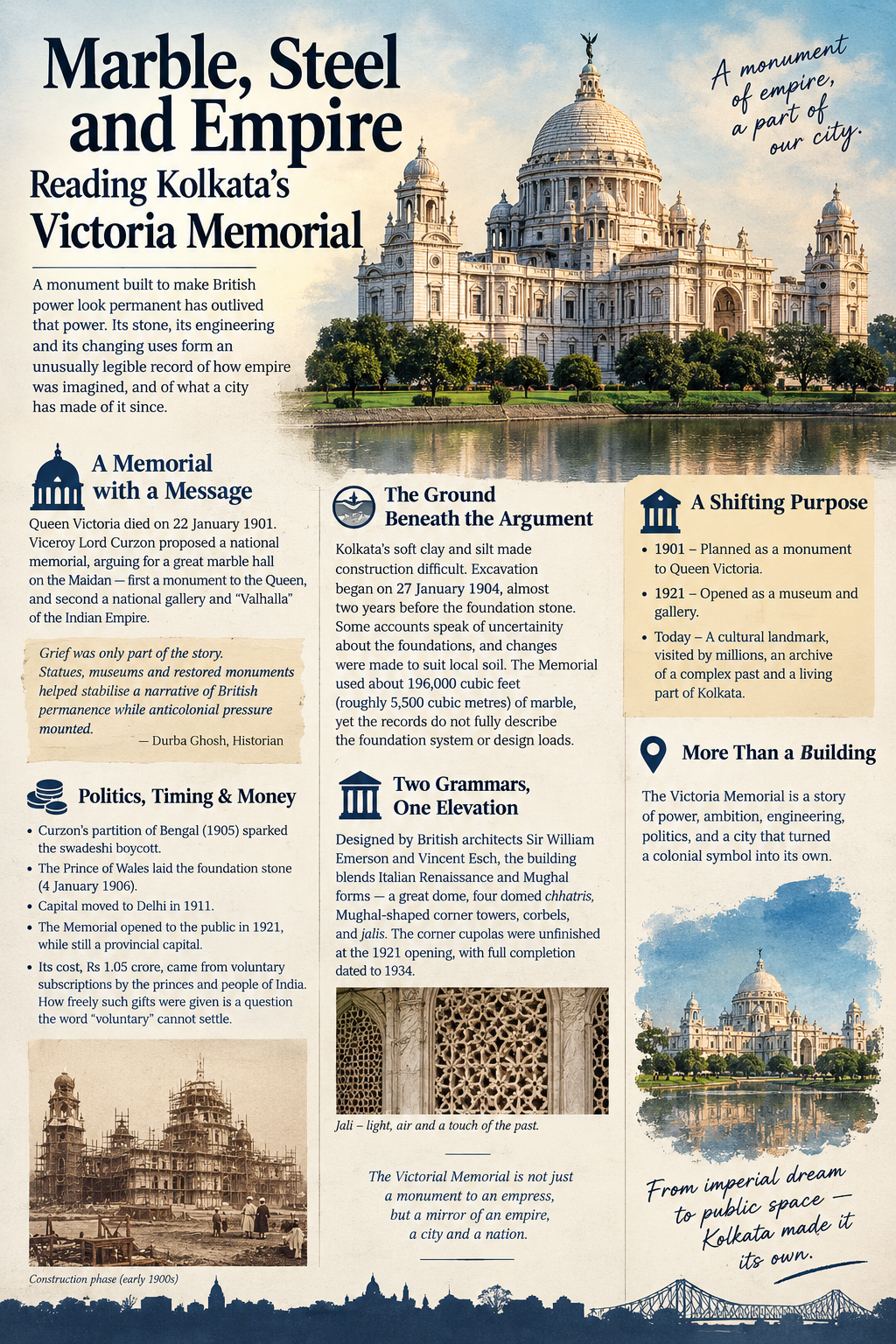
A monument built to make British power look permanent has outlasted that power.
Its stone, its engineering and its changing uses form an unusually legible record of how empire was imagined, and of what a city has made of it since.
The Victoria Memorial is usually introduced through a nickname, “the Taj of the Raj,” also the title of the Memorial’s own online exhibition.
The phrase explains less than it seems to.
On Kolkata’s Maidan, the building is a political argument made in white stone; a structure whose foundations had to be tested against the soft soils of a river delta; a case study in the strengths and weaknesses of one celebrated marble; and, beneath a bronze figure designed to turn with the wind, a museum whose purposes have shifted since it opened in 1921.
As a landmark, it looks finished.
As an object, it behaves more like an archive: of what an empire wished to say about itself in 1901, of what builders could make of that wish, and of what a city and a nation later did with the result.
The archive contains errors too, some repeated so often that they pass for fact.
Where the evidence is thin, this article says so.
A memorial with a message
Queen Victoria died on 22 January 1901. By the Memorial’s own account, the Viceroy, Lord Curzon, soon wrote to governors, public figures and Indian princes proposing a national memorial, and argued for it at Calcutta’s Town Hall on 6 February: a great marble hall on the Maidan, first a monument to the Queen and second a national gallery and “Valhalla” of the Indian Empire. The historian Durba Ghosh argues that grief was only part of the story. Curzon’s plan for a history museum predated the Queen’s death, which supplied an occasion; and in the early twentieth century, she contends, statues, museums and restored monuments helped stabilise a narrative of British permanence while anticolonial pressure mounted.
Curzon promised a hall that would teach “more history and better history than a study-full of books”: a building meant to work as a textbook. The timing sharpens the point. Curzon’s partition of Bengal took effect on 16 October 1905 and provoked the swadeshi boycott; the Prince of Wales laid the foundation stone on 4 January 1906. In 1911, with the superstructure under way, George V announced that the capital would move to Delhi. When the Memorial opened to the public in December 1921, it stood in a provincial capital. The money complicates any story of simple imposition.
The Memorial records that its cost, Rs 1.05 crore, came entirely from voluntary subscriptions by the princes and people of India. How freely such gifts were given is a question the word “voluntary” cannot settle.
The ground beneath the argument
Permanence is easier to declare than to build in Kolkata, which stands on thick, soft deposits of clay and silt laid down by the delta. The Memorial’s chronology suggests its builders knew it: excavation began on 27 January 1904, almost two years before the foundation stone, and one account records uncertainty about the foundations’ strength and tests carried out on them. One scholarly source credits the supervising architect, Vincent Esch, with redesigning them to suit local soil. The published record does not describe the foundation system or its design loads, a gap that matters because the Memorial estimates it used about 196,000 cubic feet (roughly 5,500 cubic metres) of marble.
Two grammars, one elevation
The architects were British: Sir William Emerson, already known for Mumbai’s Crawford Market and Prayagraj’s All Saints Cathedral, assisted by Esch. The Memorial’s history says Curzon insisted on the Italian Classical Renaissance idiom, and its architecture page says he regarded the Taj Mahal as the epitome of Indian architecture. The building shows both: a great dome flanked by four domed chhatris, or pavilions on columns, on a high terrace; Mughal-shaped domes on the corner towers; corbels, the projecting brackets that carry load into a wall, along the frieze of the entablature; and jalis in the arches of the upper storey.
A jali, a perforated stone screen, admitted light and air while cutting glare in Mughal practice; how much climatic work the Memorial’s jalis do is undocumented. A dome carries its weight largely in compression along its curve, passing load and outward thrust to its supports; the sources consulted do not describe how this shell is built. The corner cupolas were unfinished at the 1921 opening, and the Memorial dates full completion to 1934. The mixture was also politics. Thomas Metcalf argues that after 1857 the British pictured themselves not as foreign conquerors but as legitimate, almost indigenous rulers linked to the Mughals, the logic of Indo-Saracenic building, while classical forms went on signalling imperial authority.
The Victorian Web, citing Philip Davies, reports Curzon arguing that Calcutta, a city of European origin without an indigenous architectural type, could not take a native style. One popular legend deserves less credit: that Curzon designed the dome to outdo the Taj’s, 64 feet against 61. Curzon did not design the building, and the Memorial’s own website gives its dome as 61 feet. The Taj’s main dome is usually given as about 17.7 metres (58 feet), its drum’s inner diameter as 18.4 metres (60 feet). A 64-foot figure circulates for the Memorial’s central chamber, with an assertion that Curzon meant it to exceed the Taj, but it could not be traced to a primary source.
Which surface is measured changes the answer.
A white stone in a polluted city
Makrana, in Rajasthan, supplied the marble for the Memorial as for the Taj Mahal, and Curzon, Banglapedia notes, insisted on white marble. The Makrana white is, in the mineralogical literature, a pure calcitic marble, close to 100 per cent calcite, whose interlocking recrystallised grains give it high bearing strength. That crystalline structure underlies the stone’s reputation for durability. Heat tolerance is a separate question. Laboratory tests on Makrana marble found strength falling and microcracks forming as specimens were heated through 25 to 700°C, with a damage threshold near 500°C; on its hottest days Kolkata exceeds 40°C.
The threat to a calcite building in a humid, monsoon- washed, polluted city is chemical and optical. Calcite dissolves in weak acids; where polluted air supplies them, the US Geological Survey notes, surfaces roughen and sheltered areas, which rain does not wash, grow blackened gypsum crusts. A 2014 study of the Taj Mahal attributed its browning to deposited carbon particles and dust, which absorb light and dull a surface prized for its whiteness. Kolkata’s experience is similar. In 2018 Gulf News reported that the Culture Ministry was spending Rs 60 crore on preventive conservation, that pollution had affected the marble, and, quoting the curator of the time, that Fuller’s earth was being used for cleaning because it causes no chemical reaction.
The turning figure
Atop the dome, the Angel of Victory is, in the Memorial’s description, a giant weathercock, 16 feet tall and three tons in weight, which turns when the wind exceeds 20 km/h. It is carried on a steel rod driven through a hole in the stone finial and secured below by steel ties and braces. “Three tons” converts to 2,721.55 kilograms if American short tons are meant and about 3,050 if British long tons are; “about three tonnes” is the defensible statement. Outside accounts add that the figure is bronze, cast in Cheltenham by H. H. Martyn & Co. and shipped to Calcutta in 1920.
A photograph of 5 July 1921 shows the dome without it; by the December opening it was in place. The physics is that of any weathervane. As NASA’s educational materials explain, the wind pushes harder on the larger surface behind the pivot, and the vane swings until the forces on it are minimised, pointing into the wind. A starting threshold such as 20 km/h presumably reflects friction in the mounting; the Victorian Web notes that grease has been needed to keep the figure turning. And because the push of moving air per unit area rises with the square of its speed, the threshold is modest beside Kolkata’s Kalbaishakhi, the nor’westers: violent thunderstorms of March to May, before the monsoon.
The Alipore observatory recorded 85 and 98 km/h in two April 2018 storms. A 98 km/h wind presses about 24 times harder than a 20 km/h breeze. The steel rod, ties and braces thus do demanding work, though no design wind load appears in the sources consulted. Symbolism has its own history. Victory is a Roman figure; the Memorial’s then curator, Jayanta Sengupta, has said that British imperialists imagined themselves as Romans. A Bengali urban legend recalled in The Telegraph gave the dark figure on the white dome another name: the kalo pori, the “black fairy.”
From Valhalla to museum
Curzon’s “Valhalla” did materialise: statues of governors-general and generals stand around the building, in gardens designed by Lord Redesdale and Sir David Prain. When Calcutta’s colonial statues were taken down from public intersections in 1969, many were relocated rather than destroyed: to Flagstaff House at Barrackpore or, as the art historian Tapati Guha-Thakurta told an audience at the Memorial, to “hospitable” places within it. Sengupta has speculated that Bengal’s long association with British rule left it with a degree of immunity from statue-breaking.
Institutionally, the Memorial is an autonomous body under the Ministry of Culture, with a board chaired by the Governor of West Bengal, and is still governed, as amended, by the Victoria Memorial Act of 1903. It describes its mission as an art gallery, museum, research library and cultural space; reports 29,220 artefacts spanning three centuries from the mid-seventeenth; and calls itself India’s most-visited museum, with more than 36 lakh (3.6 million) visitors in 2023–24. The contents have moved with the politics. The Biplobi Bharat gallery, opened in 2022 on the eve of the centenary, is devoted to revolutionary nationalists and armed resistance to British rule, with an interpretive display on the Indian National Army and the flags of the Ghadar Party, the Azad Hind Fauj and the Azad Hind Sarkar.
A gallery of those who fought the empire now shares a roof with the monument to its Empress. Whether the Memorial also preserves Netaji Subhas Chandra Bose’s personal belongings is unconfirmed: a 2021 exhibition combined original artefacts with replicas, and the authenticity of at least one item was publicly challenged. Guidebooks speak of 25 galleries; the Memorial’s website names seven.
Whose monument?
Can a monument raised under colonial rule become part of the cultural identity of the society it once ruled? The evidence points two ways. Ghosh stresses original intent, and John Plunkett’s comparison of the Queen’s memorials in London and Calcutta finds the same imperial myth-making, and the frictions around Victoria’s legacy that it exposes. Organisers of a 2023 Yale conference on the Memorial described it as embodying the fraught relationships between museums, imperial histories and post- Independence India. Against that stands a record of adoption rather than erasure.
Indians subscribed to the cost, and the contractor, Martin & Co., was co-founded by the Indian industrialist Rajendra Nath Mookerjee. After independence the statues were relocated rather than smashed, and the museum took on new mandates. A Telegraph columnist recalls that, in the decades after independence, the colonial context blurred and the monument became a place of everyday city leisure. None of this settles the argument; it changes its terms. A building’s meaning is fixed not by its builders’ intentions but by what later users do with it. Critics are right that the Memorial was designed to project an empire’s permanence; its defenders are right that it is no longer only that.
What the building records
Read closely, the Memorial documents its own history in its materials: corner cupolas unfinished at the 1921 opening; almost two years between excavation and foundation stone; marble from the Taj’s quarries, and the cleaning its pollution-affected surface now demands; a bronze figure, installed a decade after the capital’s departure was announced, that is built to turn in storms and has needed grease to do so. It is at once an imperial argument and an engineering artefact, and neither reading is complete without the other. What the building says about empire has changed. So has who gets to say it.
Author: